

Navigating the Enterprise SaaS Landscape: Key Factors Shaping Your Strategy in 2026
In the fast-evolving world of enterprise SaaS, leaders face a pivotal dilemma: invest in custom development to craft a tailored solution or opt for established platforms in the classic build vs buy debate. As we step into 2026, with SaaS portfolios expanding by about seven new apps per month or 33% annually, this decision impacts scalability, costs, and competitive edge more than ever. At Belov Digital Agency, we’ve guided countless enterprises through this choice, helping them leverage WordPress-powered SaaS tools and beyond for optimal results.
This comprehensive guide dives deep into the pros, cons, real-world scenarios, and forward-looking trends, empowering you to make data-driven decisions for your organization’s future.
Unpacking the Core Trade-Offs: Control Versus Speed
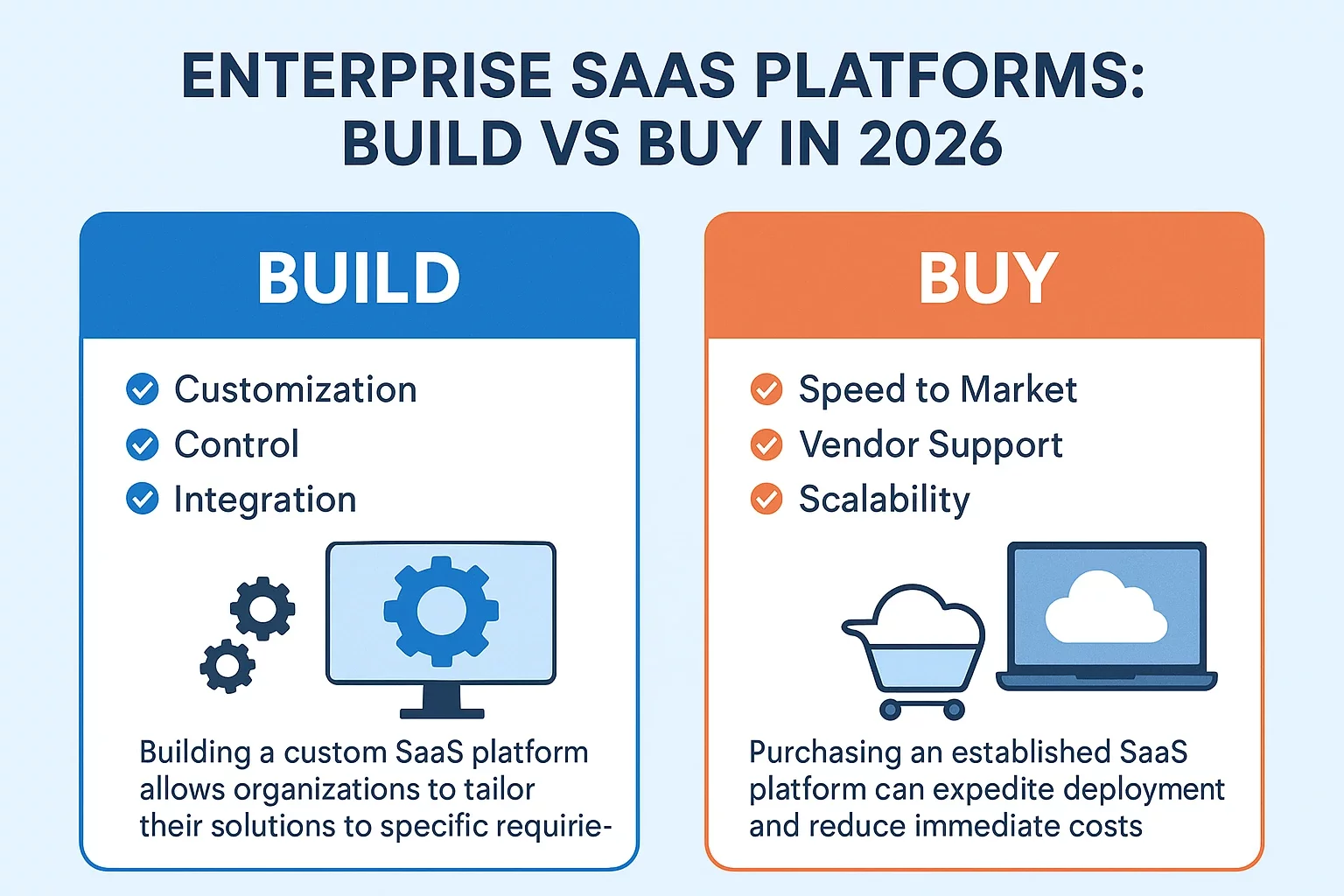
The build vs buy question boils down to balancing immediate needs with long-term vision. Building offers unparalleled control, allowing you to tailor every feature to your unique workflows, while buying delivers rapid deployment and vendor-backed reliability. For enterprise SaaS, where integration with tools like CRM and ERP is crucial, the wrong choice can lead to costly pivots.
Why Building Appeals to Visionary Enterprises
Custom development shines when your operations demand proprietary features, such as AI models trained on sensitive internal data. It builds internal expertise aligned with strategic priorities and enables seamless integration across siloed systems. However, it often results in delays—months or years—and escalating costs from ongoing maintenance.[Zylo Blog]
- Full customization: Design exactly what your team needs, from agentic AI workflows to bespoke analytics.
- Data sovereignty: Keep sensitive information in-house, ideal for regulated industries like finance or healthcare.
- Strategic alignment: Embed your competitive moats directly into the platform.
Consider a mid-sized fintech firm we partnered with at Belov Digital: they opted for custom development of a compliance dashboard integrated with their proprietary trading algorithms. The result? A 40% reduction in audit times, but only after a 9-month build phase costing $750K upfront.
The Compelling Case for Buying Proven Solutions
Buying dominates for most enterprises due to speed: value in weeks, not quarters. Platforms like Salesforce or Workday provide AI-enabled features such as license optimization and renewal forecasting, plus always-on SaaS discovery. Recurring fees ensure updates and SLAs, freeing your team for core business focus.[Appinventiv]
- Lower upfront costs: Subscription models spread expenses, with proven ROI in mature markets like CRM or payroll.
- Scalability baked in: Multitenancy on clouds like AWS handles growth effortlessly.
- Vendor expertise: Access roadmaps shaped by industry feedback, reducing blind spots.
Our case study with a UK-based logistics giant illustrates this: Switching to Zendesk‘s outcome-based pricing ($1.50/ticket) cut their support costs by 35% within months, versus a projected two-year build timeline.
Cost Breakdown: Short-Term Savings vs Long-Term Investments
Financials are a battleground in the build vs buy analysis. Buying wins on upfront affordability—OpEx subscriptions avoid CapEx shocks—but recurring fees can accumulate. Building demands hefty initial outlays plus maintenance, often 2-3x the license costs over five years.
| Pricing Model | Pros | Cons | Examples |
|---|---|---|---|
| Fixed Per-Seat | Predictable budgeting | Limited flexibility | Salesforce |
| Hybrid | Balances usage and stability | Complex forecasting | MongoDB |
| Outcome-Based | Aligns with results | Hard to quantify | Zendesk |
| AI-Driven (Token-Based) | Scales with usage | Potential invoice shocks | OpenAI |
For hosting your enterprise SaaS experiments, pair with managed WordPress hosts like Kinsta, offering developer-friendly performance at scale. Check our WordPress hosting guide for more insights.
Decision Framework: When to Choose Build Over Buy
Not every scenario favors buying. Use this matrix to evaluate:
- Assess urgency: Time-critical? Buy for immediate deployment.
- Evaluate uniqueness: Standard processes like invoicing? Buy from mature markets. Proprietary workflows? Build.
- Gauge resources: Limited devs? Buy. Strong talent pool? Consider custom development.
- Factor scale: Rapid growth? Vendor platforms scale seamlessly; custom needs redevelopment.[MakeItSimple]
- Prioritize security: High sensitivity? Build for control.
Agentic AI: A Game-Changer in 2026
Agentic AI—systems handling multi-step workflows with context-aware decisions—flips the script. For standard tasks like support triage, buy from vendors covering compliance. But if AI is your differentiator, build for governance and deep integrations.[Invimatic] Gartner’s forecast shows 40% of enterprise SaaS incorporating outcome-based AI by now, pushing unified platforms over point solutions.
Real-world example: A Canadian healthcare provider bought ServiceNow’s AI agents for triage, validating ROI in Q1 before custom-building patient workflow agents. This hybrid approach minimized risk.
Real-World Case Studies from Belov Digital Clients
We’ve seen it all at Belov Digital. A US manufacturing enterprise bought SAP for ERP standardization, saving $2M in dev costs and gaining AI forecasting. Conversely, a tech unicorn built a custom SaaS analytics layer atop Azure, fueling 150% growth via proprietary ML models.
Another standout: Migrating a legacy system to a custom development WordPress multisite on Kinsta for a SaaS marketplace. Read our full WordPress Multisite for SaaS case study.
Future-Proofing Your SaaS Stack: Trends to Watch
By 2026, AI-driven pricing and multitenancy dominate, with 70% of IT teams preferring unified SMPs for management.[BetterCloud] Trends include hybrid models—buy core, build edges—and AI-assisted coding streamlining custom development.[Innovecs]
- Outcome-based pricing aligns costs with value.
- Agentic AI demands robust governance.
- Edge computing reduces latency for global enterprises.
Empowering Your Next Steps with Expert Guidance
Whether leaning toward build vs buy or hybrid paths, the key is rigorous evaluation: Start with off-the-shelf, customize if needed, build only for true uniqueness. This pragmatic sequence minimizes risk while maximizing agility in enterprise SaaS.
Ready to strategize? Contact Us at Belov Digital for a free consultation. Our team specializes in WordPress-driven custom development, hosting optimizations, and full SaaS audits tailored for USA, UK, and Canada markets. Let’s build your winning stack together.